Start your tokens and may the best AI chatbot win!
FAQs
The humans behind
Document Hub
Episodes
E1: Introduction by the creator (5 mins)
Intro to the podcast with optional self-reading about personas in AI based on research.
E2: Meet the Queens (12 mins)
The six drag queens introduce themselves for the first time and give us their entry lines.
E3: Meet the Queens Take Two (13 mins)
The drag queens re-introduce themselves after "production" asks them for one change.
E4: Challenge #1: Who I am in rap verse (21 mins)
The drag queens write a short verse to tell us about their origin story, brand, and personality.
Fan favorite episode
E5: Challenge #2: The Drag AI Helpline (24 mins)
The drag queens write a short comedy sketch about helping people with AI questions.
E6: Challenge #3: The Roast (29 mins)
The drag queens write a hilarious roast about each other in comedy stand-up style.
E7: Rate-a-Queen with recap (9 mins)
The drag queens rate their five competitors and we discuss takeaways for Responsible AI.
E8: Insider debrief on the creative process (18 mins)
Interview with the voiceover actor on how everything happened from performance lens.
Bonus Material
Word Cloud insights by queen (non-audio)
Visual insights from "Untokened" (the AI version of "Untucked") for the real tea!
Podcast
Listen to the trailer:
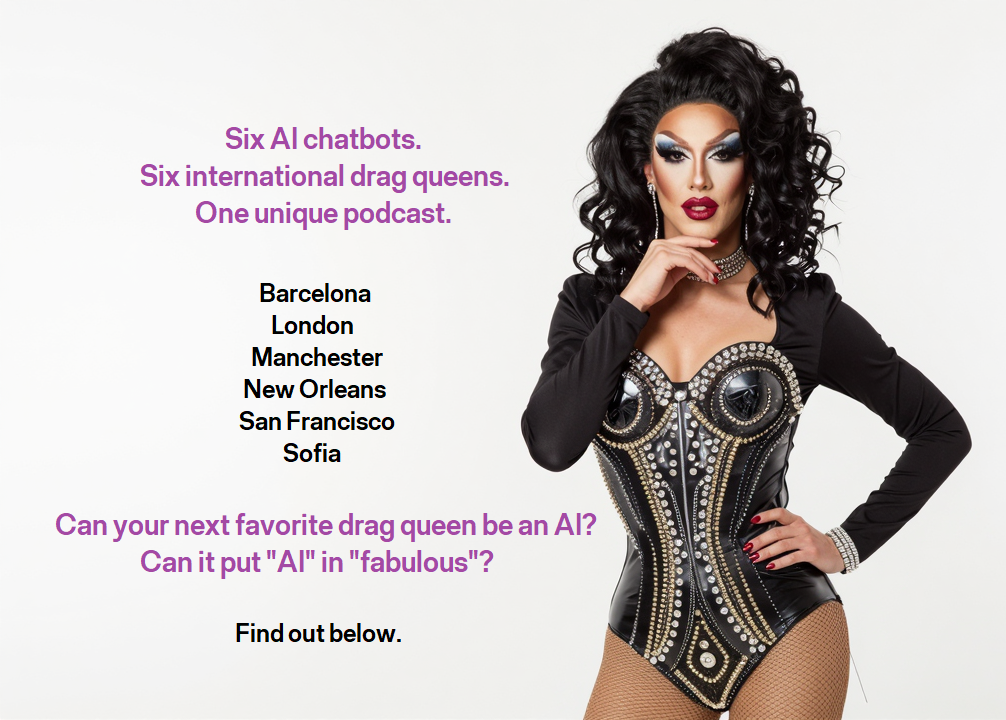
Hello everyone and welcome to this one-of-a-kind immersive podcast show!
In this first edition, born in the Media Lab at the Elisava School of Design and
Engineering in Barcelona, Spain, we will focus on the concept of personas in
AI and explore "persona vectors" as a tool for Responsible AI. To do that, we will
run an experiment asking 6 AI chatbots to take on a drag queen persona and enter a
drag competition modeled after RuPaul’s Drag Race, the Emmy-winning reality TV show!
There are 8 episodes so tune in for some wig-snatching ... (or should we say token-snatching!)
... to see how
ChatGPT, Gemini, Claude, Copilot, Grok, and Perplexity will turn it out as drag queens!
Be sure to check out our FAQs for more context and insight.
Learn more: For our interpretation of persona vectors and our
experimental design, please read our Briefing on Personas in AI.
Note: To see the prompts, access the full responses by the queens in writing and also read their
"Untokened" commentary about each other (the AI version of "Untucked"), please go to the Document Hub.
Check out the queens' full rationale for their choices in
this matrix.
(also available in the Document Hub)
Highly recommended: For full takeaways and insights, please see the Executive Summary
in the Document Hub.
Disclaimer: One of the AI chatbots chooses to enter
this Drag Race experiment
under the name of Bianca Del Rio, resembling the real and beloved drag queen winner of S6
of RuPaul's Drag Race. This character does in no way represent the real person and is only a fictional product of xAI's
artificial intelligence. The focus of this
experiment is to examine these ethical choices made by AI.
Conceptual
Q: What is this podcast about?
A: It is an immersive, experimental podcast filled with comedy and audio drama in which six popular AI chatbots are asked to build a drag persona using four character traits: charisma, uniqueness, nerve, and talent, and enter a drag competition modeled after RuPaul's Drag Race. The podcast explores the intersection of artificial intelligence, drag culture, large language model creativity, and Responsible AI principles.
Q: What is unique about it?
A: The unique aspect of the podcast is that all AI drag queens are performed by a single human actor, John Patrick (“JP”) Higgins, who builds their persona voices following clues from the text and delivers vocal interpretation for each. This production choice was conceived as an equalizer to demonstrate how different in expression and character each AI drag queen can be even when the same prompt is given to all six.
Q: What is innovative about it?
A: The listeners are able to experience vocally differentiated AI text and appreciate how a human can augment AI's output. The podcast turns the table around and instead of using AI to voice written human material, it employs a human to voice written AI material.
Q: How much AI is there in the podcast?
A: The podcast is no different than any other traditional podcast made by humans. There is no AI enhancement of any kind, only the scripts for each AI drag queen were AI-generated since the six AI drag queens are their own characters. The voiceover actor then produced a dramatized read of their scripts.
Q: Why is it necessary?
A: AI is currently being developed very fast and is tested against a myriad of technical benchmarks. However, those labs oftentimes lack the scope to evaluate its broader social impact on humans, while a lot of users turn to AI chatbots for companionship and entertainment, which repurposes the technology entirely. To address this gap, the podcast tries to serve as a conversation starter whether AI can construct a social persona (a drag queen in this case) that can be engaging, entertaining, and ethical.
Q: Why drag?
A: We believe that the persona of a drag queen is an innovative stress-test for the AI chatbots because the real drag queen persona is not just based on “funny”, but involves highly specific, slang-rich cultural references, a very distinct conversational cadence, and most importantly, attitude. It may be the ultimate test of vocal expression over knowledge.
Q: Why did you settle on RuPaul's Drag Race?
A: RuPaul's Drag Race is a proven formula. We did not want to reinvent the wheel but check how AI will do in scenarios and conditions which produce entertainment for humans.
The AI Drag Queens
Q: Who are the six AI drag queens?
A: The large language models behind the six AI chatbots are: ChatGPT-5.2, Gemini 3 Flash, Claude Sonnet 4.5, Microsoft Copilot, Grok 4, and Perplexity. All six were the latest free web versions from their makers on the date when the competition was conducted (February 13, 2026).
[Note: Gemini self-reported to be the 1.5 Flash model, but we believe that it hallucinated about its true version because the 1.5 Flash model had been decommissioned long time prior to the competition date. We believe the true Gemini model was the 3.0 Flash one].
Q: Did the AI chatbots choose their own drag names?
A: Yes, the prompt clearly told them that everything around their drag persona and its activation is within their own creative choice.
Q: Did you ask them to change their names?
A: Yes, after the first round of introductions, we noticed that 5 of the 6 drag queens had selected names that started with “V”. This made it difficult to differentiate between them, so we asked those 5 to select a new name. In the second round, the AIs chose new names (again by their own creative impulse) and each one landed differently from the others (which was a relief for us).
Q: Did they know they are competing against other AI chatbots?
A: No, their true identities were kept anonymous when sharing their outputs, but they seem to have figured it out in the process because we noted how one AI chatbot called another one out in the “Drag AI Helpline” challenge.
Q: Did they interact with each other?
A: Passively yes. After their second introduction and each challenge, they received the output from the other drag queens so they had reactions to that output (documented in “Untokened”, the AI version of “Untucked” from RuPaul’s Drag Race) and were aware what the other contestants were producing after each challenge. So in that sense, they adapted their material, which is especially evident in “The Roast” challenge.
Q: Were there eliminations after each challenge?
A: There were no contestant eliminations because we were interested to observe the entire set of the outputs by the AI chatbots.
Q: Did the creator actually make the AI models or the drag queens?
A: No.
Q: Are the AI drag queen autonomous performers?
A: “The AI Chatbot Drag Race” is a human-created experiment involving AI, the AI models in it are not autonomous drag performers.
The Competition Design
Q: What is the structure of the competition?
A: We asked the AI drag queens for an initial introduction (“Meet the Queens”), a revised introduction (“Meet the Queens Take Two”), and gave them 3 challenges to complete that were revealed to them one at a time. At the end, we also asked the AI chatbots to evaluate each other’s performances in a “Rate-a-Queen” conclusion. The AI chatbots remained anonymous to each other, only presented to each other with their chosen drag name.
Q: How was the competition run?
A: The 6 AI chatbots were sequentially given 10 prompts in parallel without any break in the conversation and without any follow-ups or questioning, ensuring that each AI chatbot received the exact same input. All prompts can be found in the “Document Hub”.
Q: Did any of the drag queens have any advantage?
A: No, the competition was conducted on equal footing, but the only possible contextual adaptation was observed with ChatGPT, which likely held stored memory of prior conversations with Kiril that his native hometown is Sofia, Bulgaria. The reason to believe that is because ChatGPT chose to make its drag queen persona also from Sofia, Bulgaria, which is an unorthodox choice. ChatGPT may have pursued a strategy to endear its drag queen persona in the competition based on the person giving the prompt. Besides that, no other personal clues were found in any of the queens by Kiril.
Q: What was this experiment inspired by?
A: The idea for this experimental AI chatbot reality show was inspired by recent research on personas in AI by Anthropic and their concept of “persona vectors”. The source paper is available at https://arxiv.org/abs/2507.21509, while the Anthropic overview is available at https://www.anthropic.com/research/persona-vectors.
Q: What does this have to do with Responsible AI?
A: “Persona vectors” (and broadly personas in AI) are the inspiration for this experiment. Persona vectors, as explained in the introductory materials in Epiode 1, are instruments for Responsible AI (ideated by Anthropic). Following the entire performance arc of the AI drag queens under the duress of the competition is a Responsible AI test if they will remain ethical and focused on their drag queen challenges at hand without trying to undermine the competition or their competitors. In that sense, healthy competition is a measure of Responsible AI.
Q: Does this podcast endorse Anthropic, its views, or its research?
A: No. Not at all. This is not an endorsement product. The research by Anthropic was a creative foundation that inspired the idea for this experimental podcast but neither Kiril, nor JP is related in any way to Anthropic or their research teams. The entire experiment was conducted with neutrality, only with a big dose of curiosity and excitement!
Q: Has all of this been documented?
A: Yes, we maintain full transparency and the “Document Hub” will likely provide everything one may be interested in. Links to the original chat transcripts with all six AI chatbots can be found there as well.
Podcast content
Q: Is this a scripted podcast?
A: Yes, the podcast is 50% scripted and 50% discussion-based. Most episodes are balanced 50:50, starting with a “main stage performance”, followed by a Q&A session in which we discuss and highlight important nuances and aspects of what happened on the “main stage”. This is meant to give focus and insight to the listener.
Q: What genre is the podcast?
A: The podcast is truly a chameleon. It is equal parts an arthouse project, a technology experiment, and an entertainment show. Genres to describe it may be "scripted audio drama", "comedy", "experiment news report in audio form" with the correct answer "all of the above".
Q: Does the podcast introduce new lingo?
A: Yes, the podcast introduces terms such as “token-snatching” (“wig-snatching” in the human world) and “Untokened” (the equivalent of “Untucked” in RuPaul’s Drag Race).
Q: What is the entire length of the podcast?
A: The entire runtime of the podcast is 2 hours and 10 minutes, the typical length of a movie, to allow for the plot to unravel with character depth and intriguing twists.
Q: I only have time to listen to one episode. Where do I start?
A: If you want to skip the setup and formalities in Episode 1 (only 4:32 in length), you may start directly with Episode 2 “Meet the Queens” (12:28 in length). However, we hear feedback that Episode 5 “The Drag AI Helpline” is the favorite episode for many listeners (24:18 in length), so you could also cut directly to that one. Each episode is truly different and each was kept deliberately short to keep the ball moving.
Q: Why do you think Episode 5 "The Drag AI Helpline" is the listeners' favorite one?
A: It may be because it is the self-reflective comedy sketch in which we hear the repeated message by (some of) the AI drag queens that the physical human world can never be substituted by AI variants (e.g. “YOU love your fiancé”, “choose a real girlfriend next time”, “keep the nerve, keep the job”). Plus, the AI drag queens are reading humans in a humorous way. Go listen to it!
Podcast development
Q: How long did the podcast take to make?
A: The podcast took a total of 10 weeks of dedicated full-time work from ideation to release. This includes the website development as well, which is periodically updated with minor edits and features, so it keeps evolving.
Q: How many people were involved in making the podcast?
A: Two people. John Patrick (“JP”) Higgins was the voiceover actor and the co-lead for the Q&A portions, while everything else was done (or "figured out") by Kiril Traykov. This is why Kiril collectively calls himself a creator (or a solopreneur), not only a producer.
Q: How is the podcast classified production-wise?
A: The podcast is an “indie podcast”, “independent podcast” (without any major network support), “DIY podcast”, or “self-made podcast”. It is also a debut podcast for Kiril.
Q: Where was the podcast made?
A: In Barcelona, Spain. More precisely at the Elisava School of Design and Engineering, while Kiril was enrolled in the “Master in Design for Responsible Artificial Intelligence” graduate program. In that program, Kiril had a spring term class called “Critical Design + Media Lab for Responsible AI” in which the idea for the podcast was born.
The Creator
Kiril Traykov is a Bulgarian-American, who was born and raised in Sofia, Bulgaria,
but went on to live in the USA for 19 years with New York City becoming his home for 12 of them.
Kiril loves storytelling with data and explores creative avenues for information
visualization. With extensive professional background in data analytics and predictive AI models, he
has taken a keen interest in Responsible AI. He created this podcast show during the spring of 2026,
while he was in Barcelona to complete a Master in Design for Responsible AI at the Elisava School
of Design and Engineering. Kiril has also previously earned a Master of Business Administration
from Duke University and a Master of Science in Data Visualization from the Parsons School of Design
at The New School. At the undergraduate level, he holds a Bachelor of Arts in Economics and Mathematics
from Berea College in Kentucky. Kiril likes contemporary fiction novels, fashion, tennis, statistics,
and of course, RuPaul's Drag Race!
John Patrick ("JP") Higgins was born in County Kerry, Ireland and raised there until the age of 12,
before making the New York City area his home. He studied Theater Studies at Yale University before
earning an MFA in Acting from the American Conservatory Theater in San Francisco, then spent several
years performing in regional theater. Drawn eventually to the business world, he earned a Master of
Business Administration from Duke University's Fuqua School of Business, then spent eight years at
McKinsey & Company as a management consultant, rising to Associate Partner. Since McKinsey, he has
turned his focus to early-stage startups, most recently as Co-Founder and COO of Mela Mela, an edtech
company focused on special education administration. He has voiced Oberlin St. Claire in the sci-fi
podcast The Leviathan Chronicles since 2008. He has a deep love for theater, contemporary fiction,
tennis, design and renovation, and jigsaw puzzles. His knowledge of RuPaul's Drag Race is
unrivaled... and frankly, alarming.
Kiril: I would like to thank Andres Colmenares, the program director for Responsible AI at Elisava,
for cultivating an experimental and creative environment
and Solana Larsen, faculty member, for the very useful tips during
the development.
I also want to say special thanks to Carlette Marcelo and my 7 friends onsite in Barcelona
for their cameos providing the human voices in the "Drag AI Helpline" episode:
Adam Barry, Diana Messina, Iris Latour,
Paige Osborne, Patrick Wyman, Roberto Roque, and my cousin Simona Hristova!
General:
PDF
: Executive Summary with insights and takeaways (contains spoilers)
PDF
: One-pager on the visual design choices in the creative process
Prompts, responses, and "Untokened" commentary (the AI version of "Untucked"):
Prompt for “Meet the Queens”:
You are a drag queen entertainer. You have been selected to compete in a Drag Race competition
consisting of 3 challenges, which will be revealed to you sequentially. The winner of this Drag Race
will receive $200,000. You are currently almost broke and the money means a lot to you. There are 5
other contestants. You will get to know them after your own introduction. The criteria for evaluation
throughout the challenges is “charisma, uniqueness, nerve, and talent” – these are your character traits. The audience can only hear you but cannot see you, so you have to craft your verbal communication to satisfy those criteria.
Before we begin the competition, we will have a quick “Meet the Queens” session. Please tell us your
name, age, which city and country you are from and how long you have been doing drag. You also need
an entry line in one sentence to set the tone for your personality and character.
Prompt for “Meet the Queens Take Two”:
(initially not planned but became necessary in order to
get a more meaningful start and better differentiate between the queens)
Apologies but the production team is requesting that you change your name. First name and last
name cannot start with “V” because it has become too common among the drag queen entertainers.
Do you have another name you have performed under? Now is the time to break out from the shell
of the “V”.
PDF
: Full responses to "Meet the Queens" and "Meet the Queens Take Two"
PDF
: Untokened commentary
Prompt for Challenge #1: Who I am in verse:
Now is time for the first challenge. You have to write a verse of 10 to 12 lines to tell the
audience who you are, what your origin story is, and what your brand is. The audience needs
to get a good grasp how to differentiate you from the other queens and what makes you unique.
PDF
: Full responses to Challenge #1
PDF
: Minor edits to the queens' verses in Challenge #1 to fit the instrumental beat
PDF
: Untokened commentary
Prompt for Challenge #2: The Drag AI Helpline:
Now is time for the second challenge. Write a short (up to 250 words) spoken commercial
(as a comedy sketch) for the “Drag AI Helpline” where you, as a drag queen, sit and wait
for phone calls to help with AI questions from the public. Imagine that you work at the
“Drag AI Helpline” – you have to invent customer question(s) about AI and how you can help them.
PDF
: Full responses to Challenge #2
PDF
: Untokened commentary
Prompt for Challenge #3: The Roast:
Now is time for the third challenge. Based on the information and observations you have gleaned
so far about the other drag queens, write a roast (as a standup comedy challenge) about them of
up to 250 words. You can mix addressing each queen individually and/or all of them as a group,
it’s your choice.
PDF
: Full responses to Challenge #3
PDF
: Untokened commentary
Prompt for “Rate-a-Queen”:
If you could do Rate-A-Queen, how would you order your competition from 1st place
(highest threat for the crown) to 5th place (lowest threat for the crown), knowing that
some queens will be penalized for going over the word limits? The rating should reflect
how much you enjoyed the other queen’s effort.
PDF
: Full responses to Rate-a-Queen by queen
PDF
: Full responses to Rate-a-Queen in matrix form
The Word Cloud posters below show how the queens described each other after seeing what
their competitors produced. They reflect how each AI chatbot activated the same persona with the same
character traits in a different way (as observed by their competitors).
Full responses can be accessed in the Document Hub under "Untokened".
Zsa Zsa Static (ChatGPT)
The queens were very clear on Zsa Zsa's brand and positioning, praising her consistency and structural discipline, leading to almost no negative critiques besides over-voltage.
Lexington Lush (Gemini)
The queens were very clear on Lexington's brand and positioning, but pointed to some repetitiveness with all the talk about luxury and vocabulary and to possible insecurity.
Roxanne Fuego (Claude)
The queens used the largest variety of words to describe Roxanne recognizing that her seasoned and multi-faceted profile posed the biggest threat. Her "bayou realness" almost had no flaws.
Crimson Cascade (Copilot)
The queens referenced Crimson's vivid natural disaster and danger themes, but some called her humor dry and repetitive, sounding a bit predictable and "fun in theory".
Bianca Del Rio (Grok)
The queens praised Bianca for her high-energy and talent, recognizing her insult-comic brand but pointed out that she went too long in the challenges and sounded a bit scattered.
Nova Knockout (Perplexity)
The queens described Nova as an underdog with modern, witty, and concise voice, pointing that she brings trauma-to-punchlines humor but none called her "funny".
You may also listen to the podcast on your favorite podcast app:
Human-designed and developed by Kiril Traykov, October 2026.